

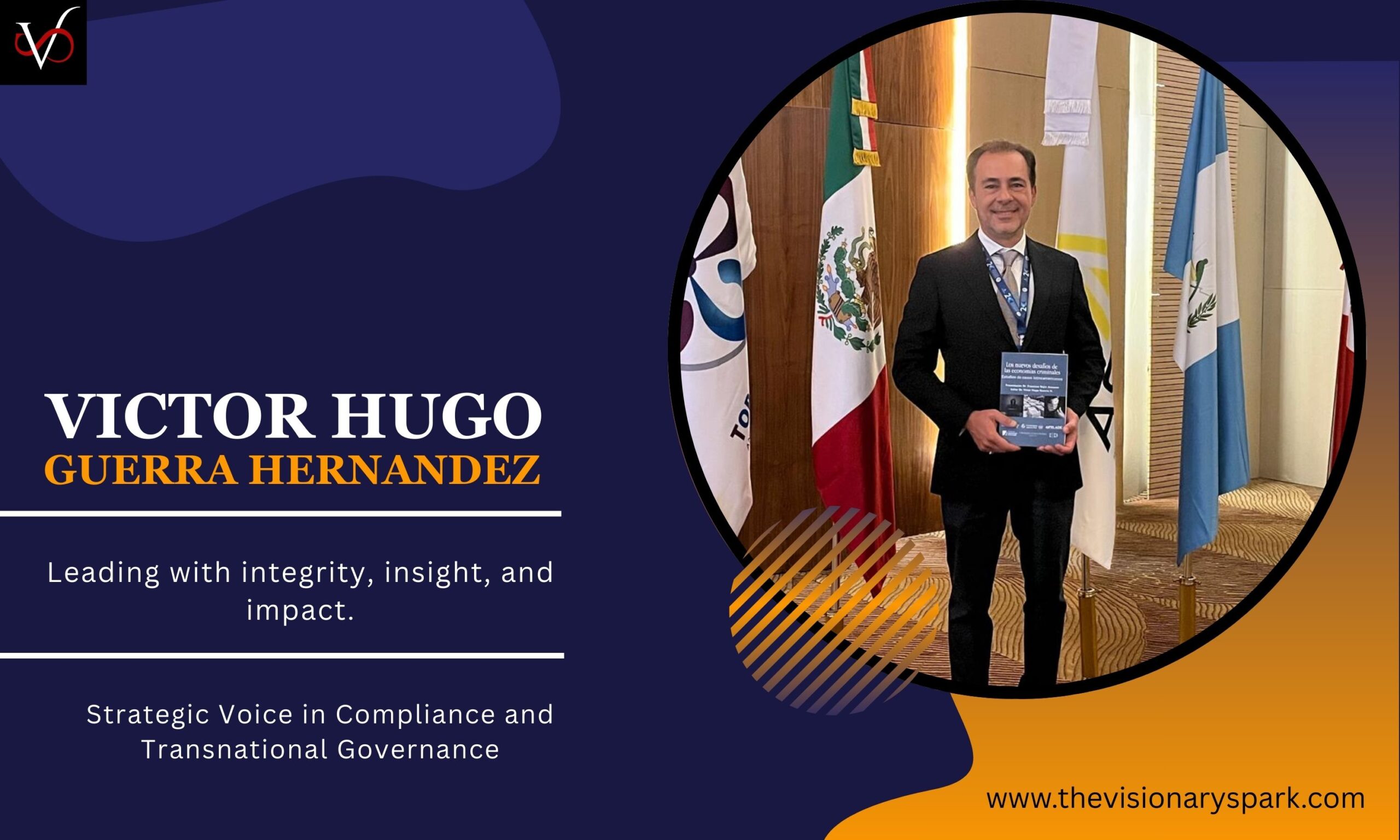
Few professionals embody the convergence of law, ethics, and strategic leadership as completely as Victor Hugo Guerra Hernández. With a career spanning over two decades across Latin America, Europe, and the United States, he has redefined what it means to lead with integrity in the modern era of compliance and governance. His journey reflects not only professional mastery but also a deep moral conviction: that integrity is the most enduring form of influence.
Early Journey & Foundations
The path from law to global trade compliance was not a sudden shift for Victor; it was a natural evolution shaped by the realities of operating in high-risk markets. Early in his legal career, he realized that conventional legal advice could no longer address the growing complexity of sanctions, anti-money laundering (AML), anti-bribery and corruption (ABAC), and illicit trade challenges. Companies, he saw, needed something beyond reactive legal guidance; they needed structured, actionable systems that protected their operations, reputations, and values.
This realization came into focus during his tenure at Philip Morris International, where Victor became deeply involved in cross-border investigations, regulatory frameworks, and large-scale anti-illicit trade programs. It was here that he developed what he calls a COMPLIANCE 360 approach, uniting legal precision with operational risk management and international coordination. Through this integrated model, he helped organizations transform compliance into a shield that safeguarded not just corporate interests but also public institutions and supply chains.
His leadership style, shaped by professional experiences in Venezuela, Colombia, Switzerland, and now the United States, reflects a global perspective grounded in empathy and adaptability. Working in high-pressure, multi-jurisdictional environments taught him to stay composed under uncertainty, to communicate clearly across cultures, and to lead by collaboration rather than command. For Victor, leadership in compliance means building bridges; connecting diverse viewpoints through respect, clarity, and purpose.
The intellectual foundations of that approach trace back to his time at Harvard Law School, where he learned the lasting value of rigorous analysis, comparative reasoning, and service-based leadership. These principles; question deeply, think comparatively, and lead ethically; continue to define his work today. From Venezuela’s regulatory reform to complex European compliance frameworks, Victor built his career on adaptability, curiosity, and the power of human connection; qualities that remain at the core of his success.
Leadership & Impact
For Victor, leading compliance at a global scale begins with a simple but powerful trio of values: truthfulness, accountability, and practicality. Truthfulness anchors integrity. Accountability ensures measurable results. Practicality translates complexity into action. Together, these values drive his ability to transform compliance programs from static frameworks into living systems of trust and performance.
He believes that business integrity must serve a dual purpose; protecting corporate interests while advancing the public good. It’s an outlook that has guided his leadership across continents and institutions. Collaboration, he emphasizes, is key: “Global compliance succeeds only when people from different cultures unite under a common ethical standard.”
Nowhere is that principle more evident than in his work at the UN UPEACE Global Chair on Illicit Trade and Transnational Crime, which he founded to bridge academia, policy, and industry. There, Victor has turned research into tangible results; developing policy briefs, risk assessment tools, and capacity-building programs for governments, law enforcement, and corporations. His mission is clear: to transform research into action that strengthens institutions and advances evidence-based policymaking across borders.
Equally important to Victor is the concept of brand integrity; a multidimensional measure that goes far beyond protecting trademarks. In today’s complex regulatory climate, brand integrity rests on transparency, responsible sourcing, ethical disclosures, and strong internal culture. It’s about ensuring that consumers, regulators, partners, and employees alike can trust a company to act responsibly in every market it serves. For him, brand trust is not a marketing asset; it’s the ultimate indicator of ethical maturity.
He also rejects the outdated notion that compliance hinders business growth. In Victor’s view, well-designed compliance systems are engines of expansion. They minimize disruption, enhance reputational confidence, and enable faster market entry. When companies meet international standards and foster ethical transparency, they don’t just avoid risk; they attract partnerships, investors, and opportunities.
Mentorship remains a defining thread in Victor’s story. Having taught since the age of twenty-four, he continues to mentor emerging professionals with one message: ethics and innovation must evolve together. He teaches them to think critically, apply practically, and lead courageously. For him, compliance is not about restriction; it’s about empowerment through integrity.
Law, Business & Governance
The intersection of law, business, and governance has always been the stage for Victor’s most impactful work. He believes the alignment between corporate goals and government enforcement begins with collaboration, transparency, and shared purpose. Compliance, he insists, should be treated not as a defensive mechanism but as a platform for constructive engagement. By proactively communicating with regulators and building credible internal systems, companies can foster partnerships that reduce friction and promote mutual trust. When public and private sectors recognize compliance as a shared path to sustainable progress, both sides win.
This philosophy came to life through one of his signature achievements: the Model Law on Illicit Trade, adopted by the Latin American and Caribbean Parliament (PARLATINO). The law harmonized legal frameworks across the region, allowing governments, enforcement agencies, and corporations to coordinate seamlessly. It has since become a blueprint for regional cooperation; encouraging intelligence sharing, joint investigations, and unified compliance standards that close gaps exploited by illicit networks. Through this work, Victor has helped turn fragmented regional efforts into an integrated front for governance and transparency.
Despite such progress, he acknowledges persistent misconceptions about compliance. Many still see it as a cost or an obstacle rather than a strategic advantage. Others delegate it to isolated departments rather than embedding it company-wide. Victor challenges this mindset. “When compliance is embraced across every function,” he notes, “it becomes a catalyst for innovation and growth.” He has seen firsthand how ethical structures, when deeply rooted, create both corporate stability and competitive differentiation.
Operating in a volatile global landscape; where sanctions shift rapidly and geopolitical uncertainties abound; Victor emphasizes agility as the key to resilience. Continuous monitoring, risk assessment, and proactive training are, in his view, non-negotiable. Partnerships with law enforcement and regulators strengthen foresight, allowing companies to anticipate change rather than react to it.
Above all, trust remains his guiding principle. For Victor, trust between corporations and authorities is earned through openness, consistency, and shared accountability. When companies demonstrate genuine integrity, they turn compliance into collaboration; and collaboration into progress.
Vision & Legacy
As he looks to the future, Victor envisions a transformative decade ahead; one where ESG and technology reshape compliance into a strategic, data-driven force. Artificial intelligence, blockchain, and advanced analytics will usher in a new era of transparency, enabling organizations to detect risk in real time, automate accountability, and enforce ethical standards with unprecedented precision. Combined with ESG frameworks that integrate environmental, social, and governance principles into decision-making, these innovations will turn compliance into a true driver of sustainable growth. “It’s not just about regulation anymore,” Victor reflects. “It’s about resilience, responsibility, and relevance.”
Parallel to his global leadership, Victor’s devotion to education and mentorship remains deeply personal. He believes that teaching is an act of legacy; a way to ensure that integrity continues to thrive through those who follow. For him, knowledge is power when it serves ethics; experience becomes meaningful only when shared. By guiding the next generation of legal and compliance professionals, he helps translate theory into actionable wisdom and reinforces the idea that leadership is measured not by authority, but by impact.
Victor’s philosophy on ethics is elegantly simple: leadership by example. When senior leaders demonstrate integrity and transparency in every decision, they create cultures where ethics are not enforced; they are lived. This principle has guided his teams and defined his legacy.
Asked to summarize his career in one line, he does so with characteristic precision: “I have built a legacy of advancing integrity and resilience in global business through compliance, governance, and cross-border collaboration.”
And to those just starting their journey, his advice is timeless; be curious, stay principled, and think globally. Understand the law, but never lose sight of its purpose: to serve people, strengthen systems, and inspire trust.