

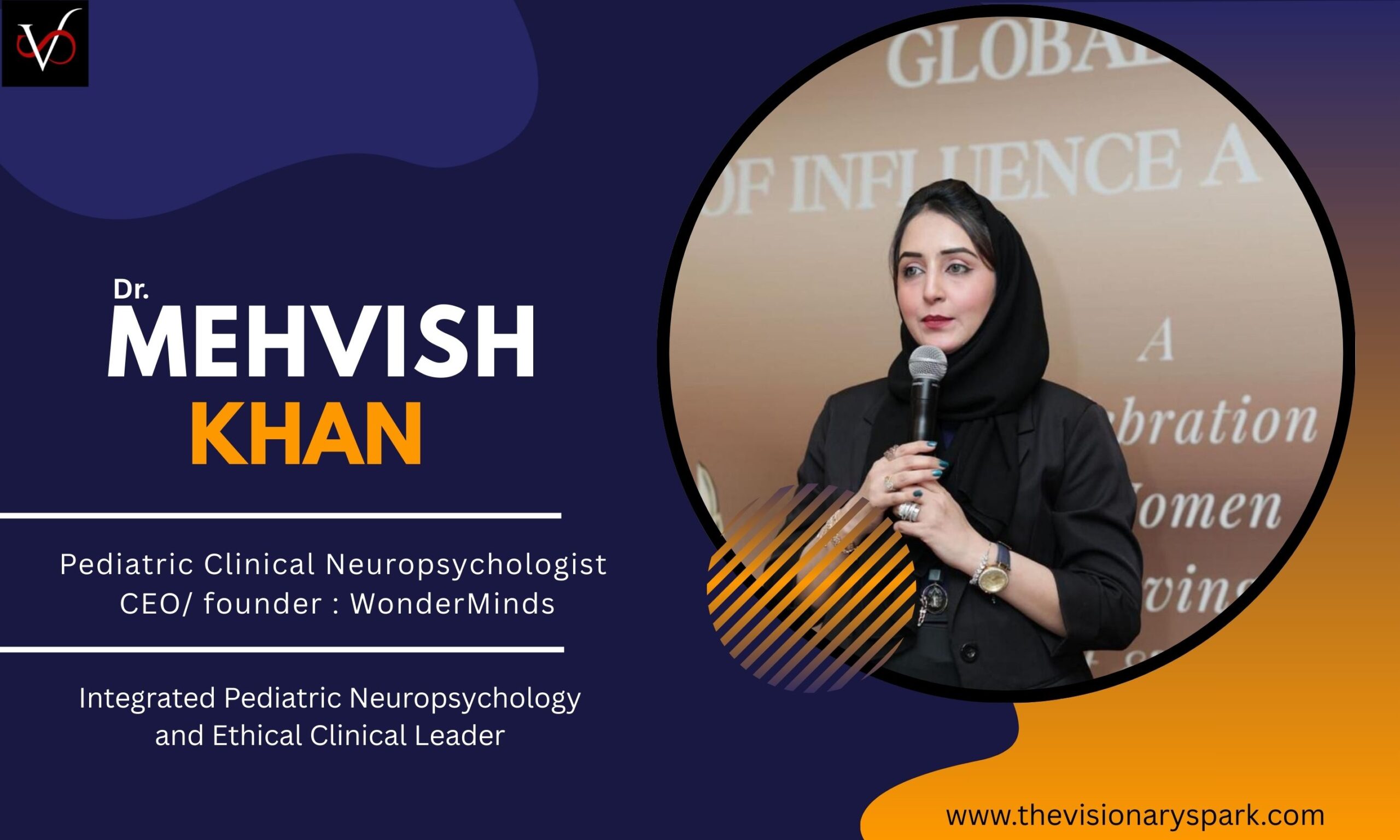
Today, Dr. Nafisa Naushin Khan, widely recognized in the Middle East as Dr. Mehvish Khan, is regarded as one of the most academically accomplished and intellectually influential voices in holistic child development and neuroeducation. Yet, when she reflects on this transformation, her response is marked not by triumph, but by humility. Even now, she admits, it feels surreal. What gives this journey its deepest meaning is not the accumulation of titles, degrees, or professional accolades, but the contrast that frames her story. She was once the child who was quietly overlooked in classrooms, perceived as academically weak, and subtly discouraged from aspiring toward higher education. That early narrative stands in stark opposition to the present reality, where she holds multiple advanced qualifications across pediatric neuropsychology, speech-language and communication disorders, and clinical psychology, supported by a PhD and years of research, clinical practice, and institutional leadership.
Today, through her initiatives and platforms such as WonderMinds and its allied programs, she continues to extend her work beyond clinical practice, creating spaces that support children, families, and educators through structured guidance and neurodevelopmental care. Her initiatives can be explored through www.wondermindsedu.com, www.wondermindscreative.com, and www.wondermindswellneshub.com, each reflecting her commitment to building accessible pathways for learning, healing, and holistic child development.
For Dr. Mehvish, this evolution is living proof that intelligence does not always announce itself early. Sometimes, it remains dormant until the environment finally allows it to breathe. Her academic success, she emphasizes, was never rooted in being “naturally brilliant.” It emerged from persistence, emotional safety, meaningful mentorship, and the freedom to learn without fear of judgment.
These experiences did more than shape her career; they shaped her philosophy. The same principles that enabled her own growth now guide the way she works with children and professionals alike. In every child she supports and every practitioner she mentors, she looks beyond early labels and surface performance, creating spaces where potential is nurtured rather than constrained. In doing so, her personal journey becomes both a testament and a blueprint, one that quietly challenges how intelligence is defined, recognized, and allowed to flourish.
Dr. Mehvish Khan does not view her early academic struggles and her current intellectual recognition as opposing forces. She sees them as deeply connected, each shaping the other in essential ways. Those early challenges cultivated empathy; her later achievements brought authority. Together, they formed credibility.
Having lived on both sides of the spectrum, invisibility and recognition, she leads today with humility rather than distance. She understands firsthand how deeply damaging labels can be, and how profoundly transformative belief can become when it is offered at the right moment. This lived experience, she believes, strengthens her clinical judgment far more than any textbook ever could, allowing her to approach children and families not only with expertise, but with genuine understanding and care.
Redefining Intelligence and Academic Excellence
For Dr. Mehvish Khan, academic excellence is no longer defined by the accumulation of degrees, diplomas, or certifications. It is defined by depth, integration, and the ability to apply knowledge in ways that genuinely transform lives.
Her extensive training across pediatric neuropsychology, speech-language pathology, neuroeducation, clinical psychology, and child psychology allows her to view each child through multiple lenses simultaneously. Cognitive functioning, emotional regulation, communication patterns, behavioral expression, and neurological development are not treated as separate domains, but as interconnected dimensions of a whole. It is this interdisciplinary perspective, she believes, that makes truly holistic intervention possible.
When she is described today as highly intelligent or academically accomplished, she does not receive those labels as personal validation. Instead, she experiences them as responsibility. Knowledge, in her philosophy, must move beyond theory and prestige. It must translate into impact, remain accessible to those who need it most, and be guided by ethical leadership. In her work, learning is only meaningful when it serves understanding, dignity, and lasting change.
After everything she has experienced, Dr. Mehvish Khan defines intelligence in deeply human terms, shaped not by metrics or timelines, but by lived understanding. For her, intelligence resists narrow definitions and rigid frameworks. It cannot be reduced to performance or pace, nor confined by comparison.
As she expresses it plainly:
- Intelligence is not speed.
- It is not comparison.
- It is not conformity.
Instead, intelligence reveals itself through the ability to adapt, reflect, problem-solve, and grow, sometimes quietly, sometimes later, but always meaningfully. In her work with children and families, she has repeatedly encountered minds of remarkable depth that were once dismissed simply because they did not align with conventional academic timelines.
These experiences have reinforced her belief that intelligence is not something to be measured at a single point in time. It unfolds when space is created for difference, patience, and understanding, a truth that continues to guide both her clinical practice and her advocacy for more inclusive educational systems.
Recognition, Responsibility, and Thought Leadership
For Dr. Mehvish Khan, awards have never marked a destination; they have served as milestones along a journey shaped by persistence, advocacy, and quiet resilience. Each recognition reflects not a moment of arrival, but years of effort that often unfolded beyond public view.
She has been honored with several national and international distinctions, including:
- Global Women of Influence Award (2025)
- Leadership Excellence in Pediatric Neuropsychology
- Global Icons of Impact
- Prestigious Achiever Awards for contributions to child mental health and special education
- Recognition as an author achieving Emblem of Excellence
- International features for published work in USA News, Women’s Insider, and other global platforms
Collectively, these acknowledgments represent the depth of her commitment to advancing child mental health, neurodiversity awareness, and ethical practice. Professionally, they amplify her voice on global platforms where pediatric mental health still requires stronger, more informed representation.
On a more personal level, these recognitions carry a quieter, deeper meaning. They serve as reminders to the younger version of herself, the child who was once told she was “not meant to study.” In that contrast, Dr. Mehvish finds both affirmation and responsibility, a reaffirmation that perseverance can reshape narratives, and that recognition, when rooted in purpose, must always translate into service.
For Dr. Mehvish Khan, being recognized as a thought leader in pediatric neuropsychology and neuroeducation brings with it a clear and unwavering sense of responsibility. Visibility, in her view, is inseparable from accountability. Influence must be exercised with intention, integrity, and an unwavering commitment to those it is meant to serve.
She is deliberate about how she uses her platform. At its core, her work is driven by four guiding commitments:
- Advocate for inclusive, flexible education systems that respect diverse learning needs rather than forcing conformity.
- Break cultural stigma around neurodiversity and child mental health, particularly in communities where silence and misunderstanding still prevail.
- Train professionals to work ethically and holistically, ensuring that expertise is matched with compassion and cultural sensitivity.
- Empower parents with knowledge rather than fear, replacing confusion with clarity and confidence.
Equally central to her leadership philosophy is how this work is delivered. She remains intentional about ensuring that everything she does stays grounded, evidence-based, and accessible, never elitist. For Dr. Mehvish, true leadership does not create distance; it builds understanding, trust, and pathways for meaningful change.
Writing, Learning, and the Power of Understanding
For Dr. Mehvish Khan, writing was never about becoming an author. It was about bridging a gap she encountered repeatedly in her clinical practice, a gap between diagnosis and understanding, between information and reassurance.
Day after day, she met parents who were overwhelmed, confused, and quietly fearful. They arrived carrying fragmented pieces of information, a diagnosis here, advice there, but very little that truly helped them understand their child or themselves. While therapy sessions were powerful, she recognized their limitations. Time constrained what could be explored. Books, however, could extend the conversation long after a session ended, offering continuity, reflection, and support.
Brainwaves to Breakthroughs emerged from her desire to translate complex neuropsychological concepts into language parents and educators could actually use. Rather than a technical manual, the book serves as a guide to understanding how children’s brains process emotions, behavior, learning, and stress. Its purpose was simple yet profound: to help families move from fear to clarity, and from confusion to actionable insight.
Connected or Controlled? was born from a growing concern she observed globally, in families, classrooms, and even within her own home. Increasingly, children and adults alike were being governed by screens rather than guided by self-regulation. The book explores the psychological and neurological impact of excessive technology use, not from a place of judgment, but from awareness. It poses an uncomfortable yet necessary question: are we using technology consciously, or allowing it to shape our minds and relationships unconsciously?
What connects both books is a single, unifying intention: empowerment through understanding. Through her writing, Dr. Mehvish invites parents, educators, and professionals to recognize that behavior is communication, that struggles are signals, and that meaningful change becomes possible when responses are guided by insight rather than reaction.
These works are also deeply personal. They reflect her own journey of being misunderstood, of navigating internal chaos, and of eventually finding regulation through knowledge and structure. In many ways, writing became an extension of her therapeutic work, reaching people she may never meet in person, but who still deserve guidance, reassurance, and hope.
For her, the measure of success is simple. If even one parent reads her words and feels less alone, or one educator pauses before labeling a child, then the purpose of these books has been fulfilled.
It is a question Dr. Mehvish Khan encounters often, sometimes with admiration, sometimes with genuine curiosity, and occasionally with quiet skepticism. Were one or two qualifications not enough?
She answers it with disarming honesty. On paper, she acknowledges, one or two master’s degrees along with a PhD would have been more than sufficient to build a successful career. But her academic journey was never driven by optics alone. It was deeply personal.
For a long time, she believed she would stop. There were moments when she wanted to stop, moments when she thought, This is enough. I’ve proven myself. Yet she kept returning to structured learning, not out of insecurity, but out of relief. Studying became her coping mechanism.
Academia offered her something the world often did not: structure, predictability, and psychological containment. In periods of emotional overload, uncertainty, or internal noise, structured learning grounded her. It quieted unnecessary thoughts and gave her mind direction.
When people ask why she did not rely on casual reading, self-development books, or informal learning, her answer is simple. Her mind does not relax without structure. Academic systems provide what she needed to function and regulate:
- Clear timelines
- Defined objectives
- Measurable outcomes
- Accountability through assessment
For a mind inclined toward ADHD-like patterns, where thoughts are abundant, fast, and often intrusive, this structure was not restrictive, it was regulating. It channeled restlessness into purpose and transformed chaos into coherence. Where self-help literature remained open-ended, academia demanded discipline. That discipline required focus, commitment, and completion, and it helped her regulate herself long before she began helping others regulate their emotions.
Each qualification she pursued was never about adding another title. It was about adding depth. Pediatric neuropsychology explained the brain. Speech-language pathology clarified expression. Clinical psychology provided emotional frameworks. Neuroeducation bridged science with classrooms. Together, they allowed her to build integrated solutions rather than fragmented opinions.
Ironically, the very thing that once made her struggle in traditional schooling, her differently wired mind, later found safety and strength within academic structure. So for Dr. Mehvish, the question was never about how many degrees were enough. It was about finding a system that allowed her to function, think clearly, and grow, and then using that system to support others who struggle in similar ways.
Today, she no longer studies to prove anything. She studies to remain aligned, regulated, and responsible. When the work involves children’s futures, she believes depth is not a luxury; it is an ethical obligation.
Legacy, Purpose, and the Message Forward
At the heart of Dr. Mehvish Khan’s journey is a message she hopes readers carry with them long after the story ends, a message shaped by experience, resilience, and deep compassion for those who are often misunderstood.
She wants readers to remember that:
- Late bloomers are not failures.
- Quiet children are not incapable.
- Potential cannot be measured at one point in time.
- Education systems must evolve to recognize diversity, not suppress it.
These beliefs are not abstract ideals; they are reflections of a life lived on both sides of visibility and dismissal. Through her work, advocacy, and leadership, Dr. Mehvish continues to challenge narrow definitions of ability and success, urging a shift toward systems that honor difference, patience, and long-term growth.
When Dr. Mehvish Khan speaks about legacy, she does so with quiet clarity rather than grandeur. For her, legacy is not about personal recognition or professional milestones; it is about the systems she hopes to leave more humane than she found them.
She envisions a future where:
- Children are understood before being judged, allowing differences to be met with curiosity rather than correction.
- Parents feel empowered, not blamed, supported with knowledge instead of burdened by guilt.
- Professionals lead with both competence and compassion, balancing expertise with empathy.
- Education becomes flexible enough to hold every mind, rather than forcing all learners into a single mold.
This vision reflects the heart of her work across clinical practice, research, and advocacy. It is a legacy grounded not in titles, but in understanding, one that seeks to reshape how children, families, and diverse minds are seen, supported, and allowed to thrive.
If Dr. Mehvish Khan could speak to her younger self today, her message would be simple, honest, and deeply affirming. It would not be framed as advice, but as recognition.
She would say:
“You were never less intelligent. You were simply learning in a world that didn’t know how to teach you yet.”
That truth, once unspoken, now anchors everything she does. It informs the way she listens, the way she leads, and the way she creates space for children and families who feel unseen or misunderstood. What was once a personal realization has become a guiding principle, shaping a life’s work dedicated to understanding before judgment, and belief before labels.
The Strength Behind the Journey
Behind every milestone in Dr. Mehvish Khan’s journey stands a foundation of unwavering family support. She expresses heartfelt gratitude to her husband, Mr. Syed Mohsin Ali, whom she describes as her backbone and steadfast pillar through every decision, challenge, and achievement. His belief in her vision has given her the confidence to pursue her path with clarity and strength. She also acknowledges her two sons, Syed Muhriz and Syed Moutaz, her greatest source of motivation and joy. Their love, encouragement, and understanding have been her emotional anchor, reminding her daily why her work matters. In her words, this journey would not have been possible without them.