

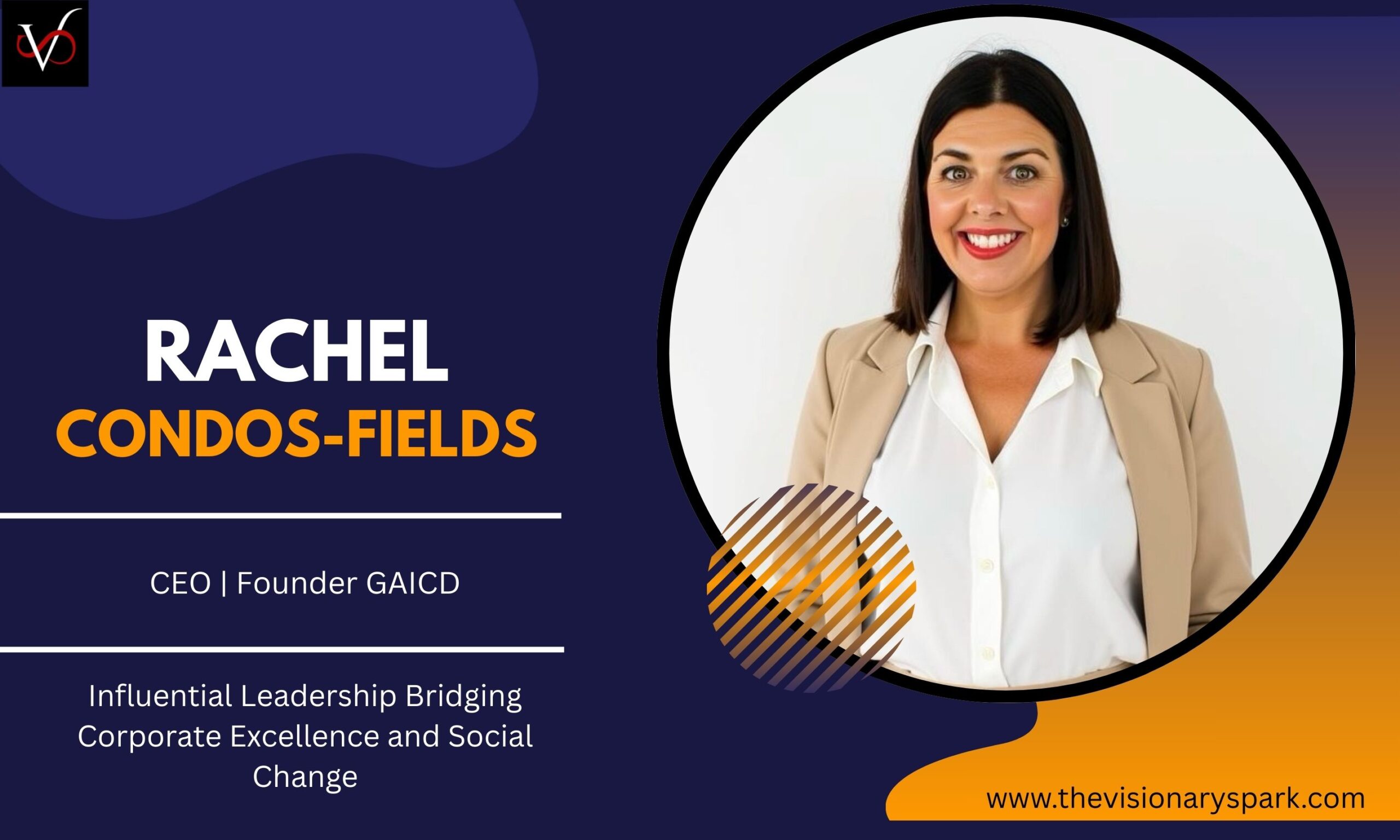
Leadership Without a Single Definition
Rachel Condos-Fields has never subscribed to a singular definition of leadership. Her career, spanning corporate enterprise, elite sport, governance, and social impact, has been shaped by contrast rather than continuity. It is this movement between worlds, each governed by different pressures, languages, and expectations, that has refined her leadership philosophy into something both grounded and expansive. Rather than pursuing authority for its own sake, Rachel has consistently gravitated toward roles where responsibility, purpose, and people intersect.
In the early stages of her career, Rachel was immersed in highly structured corporate environments where accountability was non-negotiable and outcomes were measured with precision. Performance mattered. Targets mattered. Results mattered. These environments taught her discipline, clarity, and the importance of follow-through. They also taught her how systems operate, how decisions ripple outward, and how leadership behaviour sets the tone for culture. Yet even in these performance-driven settings, Rachel was drawn not only to what was achieved, but how it was achieved. She became acutely aware that sustainable success is rarely built on pressure alone, but on trust, alignment, and shared commitment.
The Influence of Sport and the Human Side of Leadership
Sport introduced another dimension entirely. Whether within elite competition or community-based programs, Rachel witnessed the power of collective belief. Teams succeed not simply because of talent, but because of trust, connection, and shared purpose. In sporting environments, leadership is visible and immediate. Actions are noticed. Credibility is earned through consistency. For Rachel, sport revealed the emotional architecture of leadership, the unspoken bonds that allow individuals to push beyond perceived limits when they feel supported and valued.
Governance roles later required her to step back again, to zoom out and think systemically. Here, the focus shifted from immediate outcomes to long-term stewardship. Decisions had ethical weight. Accountability extended beyond individuals to communities, stakeholders, and future generations. Governance demanded curiosity, restraint, and courage in equal measure. It was within this space that Rachel fully crystallised her belief that leadership is not about control, but about clarity. Not about authority, but about responsibility. Not about dominance, but about creating environments where people feel safe enough to perform and strong enough to belong.
From Corporate Leadership to Purpose-Driven Impact
After nearly two decades in senior corporate leadership, Rachel reached a point of recalibration. It was not burnout, nor dissatisfaction, but alignment that prompted change. She began asking herself whether her professional energy was being applied where it mattered most to her personally. She had spent years working alongside athletes, organisations, and institutions, and had seen firsthand the influence sport holds beyond performance. Athletes shape culture, inspire communities, and embody resilience, yet too often their value is narrowly defined by results and timelines.
The realisation that many athletes are supported only within a short competitive window sat uneasily with her. Performance may peak for a few years, but life extends far beyond that moment. Rachel saw athletes grappling with uncertainty, identity shifts, and financial instability, often without the structures needed to transition confidently into life beyond competition. This gap, between potential and preparedness, between recognition and reality, became the catalyst for The WattleNest.
Founded in November 2022, The WattleNest was intentionally designed to sit at the intersection of sport, business, and social impact. Its purpose is not transactional, but transformational. For athletes, it offers pathways to sustainable futures, built on capability, confidence, and connection rather than dependency. For organisations, it provides a framework to engage with sport in ways that are authentic, values-aligned, and human-centred. Rachel did not want to create another program that extracted value from athletes; she wanted to build an ecosystem that invested in them as whole people.
Redefining Leadership Through Governance and Mentorship
As The WattleNest began its work, Rachel encountered realities that challenged prevailing assumptions about elite sport. What surprised her most was not the intensity of competition, but the emotional isolation that often accompanies it. From the outside, elite sport appears glamorous and secure. Inside, it is frequently precarious. Short-term contracts, limited career pathways, and relentless performance pressure create an environment where identity becomes tightly bound to results. When injury, deselection, or retirement occurs, many athletes find themselves unanchored.
Rachel observed how much responsibility athletes carry, representing teams, sponsors, and communities, often without the tools or networks to navigate life beyond competition. Confidence on the field does not always translate to confidence off it. The gap between public perception and lived experience reinforced her belief that leadership, in any context, must address the whole person, not just the output.
Across every sector Rachel has worked in, certain leadership qualities have remained essential. Decisiveness is one. Leaders must be willing to make informed decisions, even when certainty is elusive. Courage is another, the willingness to act in alignment with values, particularly when it would be easier not to. Compassion underpins both, ensuring that decisions are made with humanity, not detachment. Curiosity keeps leadership relevant, encouraging learning rather than defensiveness. Integrity binds it all together, creating trust through consistency between words and actions.
Rachel is clear that leadership often requires stepping forward even when the odds are against you. There are moments when logic suggests restraint, but values demand action. For her, those moments define leadership more than any title ever could. People may forget what was said, but they remember how leaders show up when it matters most.
Purpose, Performance, and the Courage to Lead Differently
In conversations about business and social impact, Rachel rejects the idea that purpose and profit sit at opposite ends of a spectrum. She sees purpose as the anchor that gives commercial outcomes meaning and longevity. When organisations understand why they exist, partnerships deepen, trust strengthens, and performance improves organically. Purpose, when embedded authentically, becomes a strategic advantage rather than a marketing exercise.
Balance, she believes, comes from honesty. Not every initiative requires a social lens, and forcing one can dilute both impact and credibility. However, when purpose is aligned with strategy, it enhances resilience and relevance. Organisations that understand this are better equipped to navigate uncertainty, because they are grounded in something more enduring than short-term metrics.
Rachel’s governance experience has sharpened her perspective on leadership at the highest levels. She believes boards must evolve to remain relevant in a rapidly changing world. That evolution begins with curiosity, a willingness to question assumptions rather than defend tradition. Diversity of lived experience is essential, not as a symbolic gesture, but as a strategic necessity. Boards disconnected from the realities of employees, customers, and communities risk irrelevance.
Engagement, Rachel argues, must extend beyond the boardroom. Meaningful stakeholder connection provides insight that data alone cannot. At the same time, boards must be willing to challenge entrenched power structures and outdated norms. Governance today requires courage as much as compliance. Adaptability, ethical clarity, and accountability are no longer optional, they are foundational.
Mentorship has been a constant thread throughout Rachel’s career. Some of the most influential guidance she received came not from formal programs, but from individuals who took the time to ask thoughtful questions. Rather than offering answers, they helped her develop clarity and confidence. This approach shaped how she now mentors others, focusing less on instruction and more on empowerment.
In an era where careers are increasingly non-linear and leadership demands are intensifying, Rachel believes mentorship matters more than ever. People need safe spaces to test ideas, to fail without fear, and to build confidence through experience. Mentorship provides not just guidance, but permission, permission to explore, to question, and to grow.
Legacy, Equality, and the Measure of Real Impact
Looking to the future, Rachel sees sport as one of the most powerful platforms for social impact. Its ability to cut across social divides and create shared language is unmatched. When used intentionally, sport can shift conversations around inclusion, mental health, gender equality, and leadership. For young people in particular, sport can offer visibility and belonging where other systems fall short.
Rachel is especially passionate about sport’s role in fostering inclusion and wellbeing. When athletes are supported holistically, they become powerful advocates for change. When communities engage with sport beyond entertainment, they unlock its capacity to build connection, resilience, and shared identity.
On the topic of gender equality, Rachel acknowledges the progress that has been made. Visibility and representation have improved, particularly within leadership pathways and sporting environments. However, she is equally clear that visibility alone is not enough. Structural inequities persist, particularly around pay equity, caregiving expectations, and access to decision-making power.
For Rachel, equality is not simply about opening doors. It is about redesigning systems so that women, and other underrepresented groups, do not have to expend disproportionate energy to remain in the room. True equality is measured not by presence alone, but by influence.
Leadership has also reshaped Rachel’s understanding of resilience. Early in her career, resilience was synonymous with endurance, pushing harder, staying longer, doing more. Experience has taught her otherwise. Today, resilience means knowing when to pause, when to reflect, and when to ask for support. It is about sustainability, not sacrifice.
Professionally, resilience is anchored in purpose and perspective. When leaders understand why they do what they do, setbacks become lessons rather than failures. Personally, resilience has taught Rachel the importance of self-compassion. Growth, she has learned, often emerges from discomfort, not certainty.
Her definition of success has evolved accordingly. Once measured by titles, progression, and external validation, success is now defined by impact, alignment, and sustainability. Rachel measures achievement not by personal advancement alone, but by the opportunities she creates for others, the trust she builds, and the systems she leaves stronger than she found them.
At this stage of her journey, legacy has become a central consideration. Rachel hopes to leave behind a model of leadership that proves strength and humanity are not mutually exclusive. She wants athletes to be valued for who they are, not just what they win. She wants future leaders to feel empowered to lead with purpose, courage, and empathy.
Central to that legacy is empowerment. Rachel is deeply committed to ensuring that minority groups are not only included, but genuinely heard and trusted in spaces where decisions are made. Inclusion without influence, she believes, is incomplete. True leadership creates room for diverse voices to shape outcomes, not merely observe them.
In lifting others as she goes, Rachel Condos-Fields continues to redefine what modern leadership looks like, not as a position to be held, but as a responsibility to be carried with care, clarity, and conviction.