

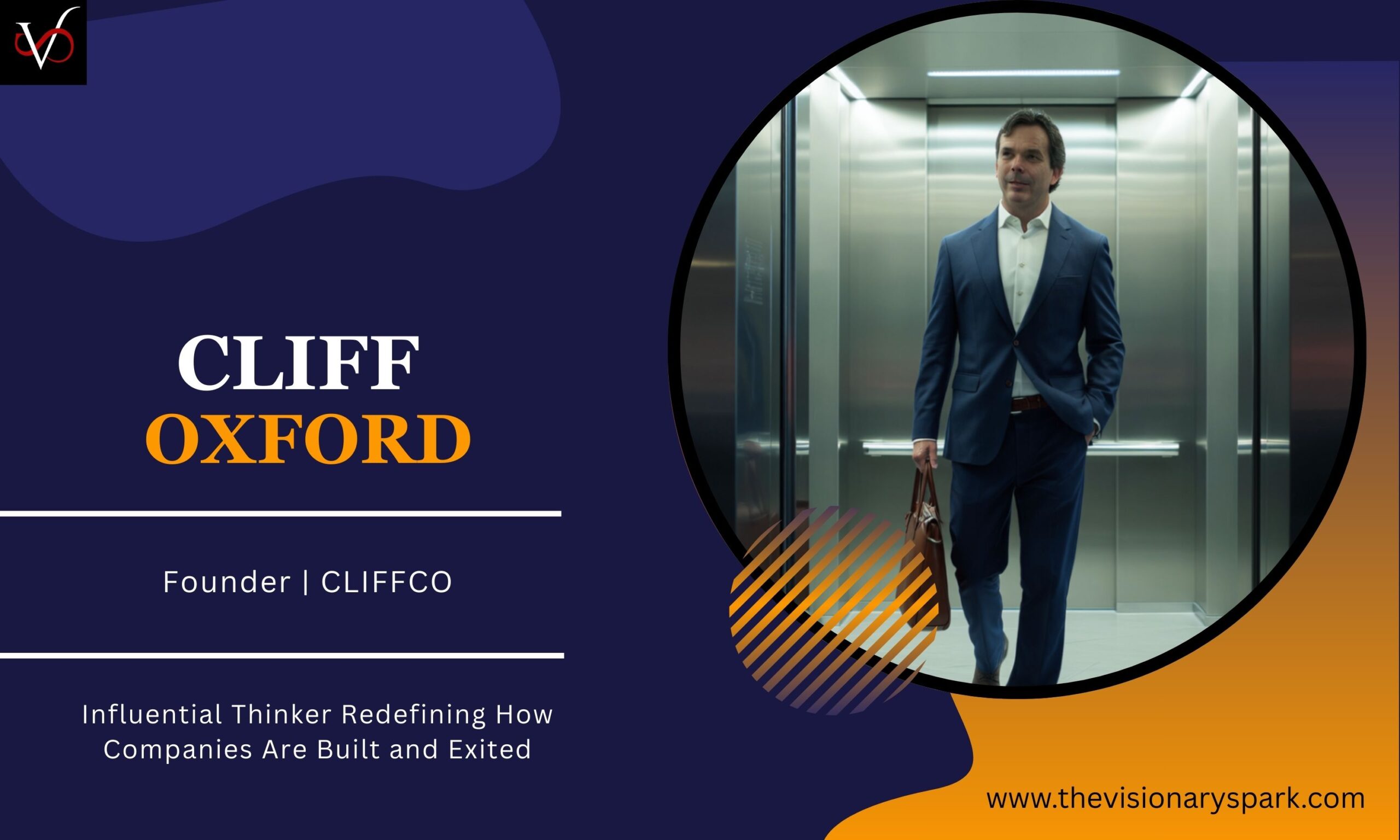
Cliff is the founder of CliffCo, a private, membership-based business platform for category-leading entrepreneurs and CEOs focused on growth, M&A strategy, and enterprise value creation. He previously founded STI Knowledge, growing it to rank 13th on the Inc. 500, and later established the Oxford Center for Entrepreneurs, which helped create the first accredited clinical MBA curriculum in the United States.
A former columnist for The New York Times and Forbes, Cliff is the author of Lambs to Leaders, Know Grow Exit, and A Redneck Reverie. His work bridges execution, education, and exits, with more than 2,000 successful client engagements across industries.
Based in Atlanta, Cliff is known for designing environments where serious entrepreneurs make better decisions under pressure.
Designing the Room Where Serious Entrepreneurs Decide
There are leaders who inherit systems, and then there are those who learn early that systems can be redesigned. Cliff belongs firmly to the latter.
Long before boardrooms, deal tables, and exits, his instincts were shaped in the Okefenokee Swamp, a place where consequence is immediate and margin for error is thin. Survival there is not theoretical. If something goes wrong, it does not linger politely. It disappears. Problems must be addressed now, or first thing in the morning, because delay often means loss.
That early environment instilled what Cliff believes is one of the most underrated skills in entrepreneurship: the leadership of urgency.
It is a principle that would quietly govern everything that followed, from how he built companies to how he advises founders under pressure today. Urgency, in Cliff’s world, is not impatience. It is responsibility. It is the discipline of recognizing that windows close, momentum fades, and hesitation quietly erodes opportunity.
Learning Inside the Machine
Before founding companies of his own, Cliff made a deliberate choice to step inside one of the world’s largest corporate systems. He often advises aspiring entrepreneurs, including his own son, to do the same.
Before you start a company, he believes, you should work for a global brand. See how a company functions. Understand how it works when it succeeds, and more importantly, how it fails. Large organizations expose future founders to scale, process, accountability, and consequence in ways no startup ever could.
There is another advantage that often goes unspoken. Global companies invest heavily in training. For an aspiring entrepreneur, that investment becomes a form of paid education, sharpening judgment long before personal capital, reputation, or livelihoods are on the line.
Yet for all the value Cliff gained inside corporate life, he felt misaligned with the structure itself.
Almost every day, he recalls, he felt confined. Not socially isolated, but intellectually constrained. Ideas surfaced constantly, but there was little room to test them, challenge assumptions, or redesign the system from within.
At the time, he had never been exposed to people who owned companies. Ownership was not yet part of his mental map. Like many, he assumed careers followed a single path: you worked for companies because that was simply how the world worked.
That quiet tension between ideas and permission would eventually become impossible to ignore.
Building with Restraint, Not Noise
When Cliff founded STI Knowledge, he did so without subscribing to the mythology of constant disruption. His approach to growth ran against the grain.
“When you’re walking on thin ice,” he says, “you don’t jump up and down on it.”
Building a brand, in his view, requires finesse more than force, depth more than spectacle. Growth is not about spreading wings wide at every opportunity, but about knowing precisely when to advance, when to retreat, and when to re-enter the battle with clarity.
STI Knowledge emerged during a formative moment in enterprise technology. The company helped pioneer what would become the CRM industry, eventually certifying and training a vast majority of Fortune 500 companies on STI standards. Yet Cliff was acutely aware that scale attracts attention, and attention invites competition.
As larger players rushed into the space, STI did not attempt to outshout them. Instead, the company narrowed its focus. Cliff identified where depth mattered more than dominance and positioned STI within a niche that rewarded expertise over breadth.
It was a strategy rooted in patience and discipline, and it worked. But the lessons learned there would extend far beyond market positioning.
Why Most Exits Fail the Entrepreneur
Cliff is blunt about the state of exits in entrepreneurship. The data, he argues, tells a troubling story.
Eighty percent of entrepreneurs, he notes, are unhappy one year after a deal. Financially liquid, perhaps, but strategically disoriented and emotionally dissatisfied.
At CliffCo, the goal is inverted. The aim is not to close deals quickly, but to ensure founders are excited and satisfied ten years after the deal. That standard requires discipline, patience, and a willingness to say no far more often than yes.
Many founders, Cliff believes, attempt to exit before there is truly something worth selling.
The imbalance at the negotiation table compounds the problem. Entrepreneurs often walk into deals unaware that they are facing what Cliff describes as the “buyers club,” an ecosystem of investment bankers, brokers, lawyers, accountants, and consultants who will transact deals for an entire career.
For the entrepreneur, the exit is singular. For the other side, it is routine.
That asymmetry leads founders to accept terms they do not fully understand and concessions they assume are customary. Money is left on the table. Control is quietly surrendered. Futures are compromised.
“The other side is not your friend,” Cliff says plainly. They are paid to acquire companies at the lowest price and on the harshest terms possible. Forgetting that reality is not optimism. It is vulnerability.
Writing for Clarity, Not Motivation
Cliff’s authorship mirrors his approach to entrepreneurship: direct, practical, and unapologetically execution-focused.
A legitimate criticism of his books, he acknowledges, is that they are almost too practical, even clinical. That is intentional.
Entrepreneurs do not need motivation, he believes. They already have it. What they need is a framework and a compass pointing north.
Know Grow Exit lays out the architecture for building a brand into a durable enterprise. Lambs to Leaders teaches first-time founders the language of business itself, the vocabulary required to move from instinct to fluency. A Redneck Reverie ties those ideas back to identity and origin.
Cliff skips the speeches. He delivers structure.
For him, clarity is the highest form of respect an author can give an entrepreneur.
Rewriting Business Education
Cliff’s critique of traditional business education is not ideological. It is historical.
Modern MBA programs, he explains, were largely shaped in the mid-twentieth century to serve the needs of large corporations. They were designed to produce quantitative graduates who could generate statistics, not founders who could build companies.
Entrepreneurship, when it appeared at all, occupied the margins. Strategy and revenue recognition, both vital to building enterprises, made up only a small fraction of the curriculum he experienced.
In 2002, Cliff approached Emory with a proposition. The future, he argued, would belong to students who wanted to start businesses, not simply manage existing ones. That shift required more than spreadsheets. It required an understanding of culture.
At the time, the response revealed how early the idea was. He was asked a simple but telling question: What is culture?
What was once absent would later become fashionable, often misunderstood and misapplied.
An economic downturn changed the conversation. Traditional job pipelines collapsed, and entrepreneurship moved from elective to necessity. With strong leadership support, Cliff helped create an accredited, experiential MBA curriculum that treated entrepreneurship as a discipline, not an abstraction.
But institutions move unevenly. As leadership shifted, bureaucracy replaced momentum. Rather than fight a system he no longer believed could evolve fast enough, Cliff made a decisive choice.
He left, taking with him the clarity that the work mattered, even if the structure no longer did.
From that departure emerged the Oxford Center for Entrepreneurs.
Completion Without Sentiment
When the Oxford Center was ultimately acquired, Cliff described the moment with one word: relief.
For years, he had written a daily “Morning Report.” What began as a creative exercise quickly became a discipline. He wrote it hundreds of times before turning it over. Today, it continues under new stewardship.
More importantly, the mission had been executed. The Center had created an accredited entrepreneurial MBA curriculum that treated entrepreneurship seriously. Validation followed quickly, including early adoption from elite institutions.
Cliff had been early once again.
Just as STI Knowledge secured major enterprise accounts early in the CRM movement, the Oxford Center found traction before the market fully caught up.
The acquisition was not an ending. It was confirmation. The system worked. The platform was ready to scale beyond him.
That clarity freed him to build what came next.
Why CliffCo Exists
CliffCo was never designed to replicate what already existed.
“We go places others don’t,” Cliff says, “in content, connections, travel, and a collective desire for optimism.”
The distinction is intentional. CliffCo is not built around information exchange alone. It is engineered around shared experience. Members engage in conversations others avoid, form connections that are not transactional, and participate in experiences that move beyond boardrooms.
Travel is not leisure. It is exposure. Physical movement becomes a tool for intellectual expansion, forcing perspective shifts that cannot be achieved through schedules and screens.
At CliffCo, motivation is not manufactured. It is experienced.
“If we need motivation,” Cliff says, “we trek across the Tetons together, take a walk through the Mekong Delta, or sit in one of our think tank sessions.” Exposure, not exhortation, is what sharpens ambition. Curiosity does the work that speeches never can.
In one such session, members engaged with Dr. Herman Pontzer, a Duke University anthropologist whose month-long immersions with remote African tribes reshaped modern understanding of human metabolism. The lesson was not about endurance or hustle. It was about perspective, context, and how radically different environments change how we think.
For Cliff, curiosity is the most durable form of motivation. It pulls leaders forward without theatrics or posturing. That belief also explains his scepticism toward the modern cottage industry of motivational speaking.
“Ninety-nine percent of it,” he argues, “is counterproductive to entrepreneurial success.”
War stories and slogans may create temporary emotional spikes, but they rarely change decision-making. CliffCo rejects that model entirely. Instead, it places founders in environments where curiosity is unavoidable, assumptions are challenged, and motivation emerges naturally, because the room demands more of them.
What binds the room is not profession or status, but posture. The most productive, positive people in the world who want to build prosperity while making the world better.
For many entrepreneurs, the problem is not access. It is the absence of the right room.
Built to Be Uncomfortable
Cliff is deliberate when he resists the word community. Not because CliffCo lacks connection, but because the word often implies comfort and consensus.
“What we really are,” he says, “is a group of outliers.”
CliffCo attracts founders who intend to own a lane, not blend into one. Category leaders tend to disrupt the status quo, and in doing so, often outgrow traditional communities.
There is an element, Cliff notes with a smile, of One Flew Over the Cuckoo’s Nest to it.
CliffCo is not designed to protect conformity. It is built to test ideas, unsettle complacency, and hold disagreement without fragmentation. Networks demand contribution. They reward clarity and courage over validation.
Innovation, Cliff believes, rarely emerges from consensus. It emerges from collision.
Decisions Under Pressure
This philosophy becomes tangible under pressure.
Members technically have access to a 24/7 “bat line” for urgent decisions. In practice, it is rarely needed.
The real work happens live.
In CliffCo think tank sessions, members bring real decisions into the room. Deals about to be signed. Executives about to be fired. Nothing hypothetical. Nothing sanitized.
Recently, a company entered a session on the verge of finalizing a deal with a state lottery. On paper, it looked attractive. In the room, it did not survive scrutiny.
They killed the deal in the meeting.
For Cliff, that outcome is success. CliffCo does not exist to accelerate decisions. It exists to slow them down just enough to ensure they are right.
Pressure is not avoided. It is engineered, shared, and resolved.
The Final Word on Negotiation
After decades of exits and negotiations, Cliff’s advice is deceptively simple.
Embrace the other side. Understand what they want and what defines success for them.
But never split the difference.
Compromise for its own sake creates deals that satisfy no one and quietly erode long-term value. The goal is not to meet in the middle, but to design outcomes where incentives align cleanly.
That philosophy underpins everything Cliff has built, from companies to classrooms to CliffCo itself.
Clarity before consequence.
For Cliff, that is not just good business. It is responsible leadership.