

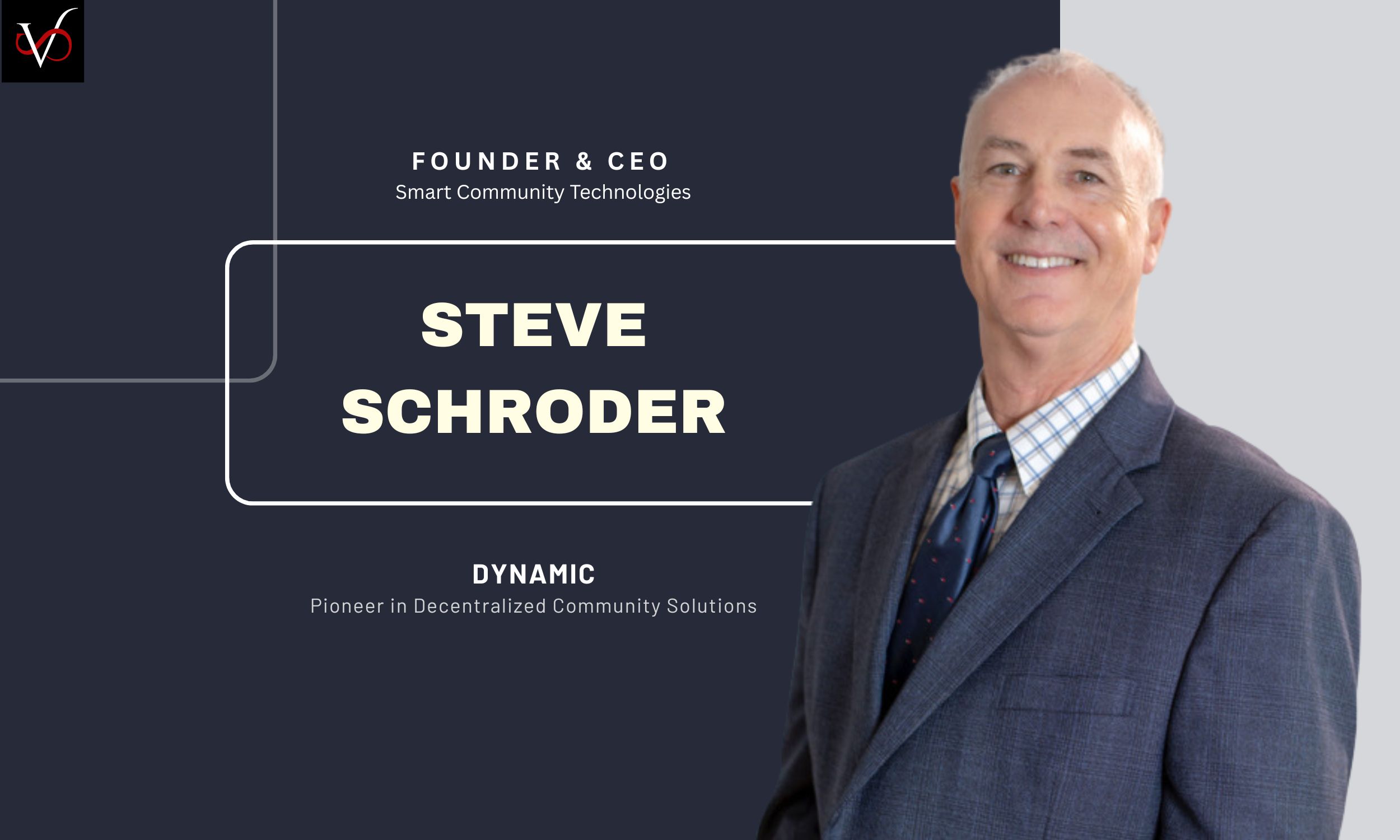
From Survival to Service
For much of his professional life, Steve Schroeder was doing what successful entrepreneurs are expected to do. He was building businesses, developing innovative marketing and loyalty solutions, exploring emerging technologies, and helping organizations create stronger connections with their customers. From the outside, his career appeared to follow a familiar entrepreneurial path, one defined by growth, opportunity, and a relentless drive to create value.
Yet today, when Steve reflects on his journey, he rarely begins by talking about business.
He talks about family.
He talks about caregiving.
He talks about faith.
He talks about purpose.
And he talks about a series of life experiences that forced him to completely rethink what success actually means.
As the founder of Smart Community Technologies, DeCoy, FAAST, FAAST4Kids, NOSTR Fundraising, and The Hornet’s Nest Podcast, Steve has spent decades exploring the intersection of technology, education, fundraising, community development, and economic empowerment. His work touches everything from customer loyalty systems and nonprofit fundraising to Bitcoin education and decentralized communication networks.
But the deeper story behind those ventures is not technological.
It is profoundly human.
Over the past decade, Steve’s life has been shaped by challenges that transformed both his personal outlook and professional mission. A life-threatening cardiac arrest, years of caregiving for his son Gentry, the loss of both parents within months of one another, and an ongoing search for meaning pushed him toward a vision that extends far beyond entrepreneurship.
Today, Steve sees technology not as the destination, but as the vehicle.
The mission is helping people.
Everything else follows from there.
“The two greatest days of our lives are the day we are born and the day we discover why.”
– Steve Schroeder
The Cardiac Arrest That Changed Everything
In 2014, Steve experienced a cardiac arrest that would become one of the defining moments of his life.
While many people speak about turning points in hindsight, Steve can point to a specific event that forced him to confront questions most people spend their lives avoiding. Facing mortality has a unique way of stripping away distractions and exposing what truly matters. For Steve, the experience became far more than a medical emergency. It became the beginning of a prolonged period of reflection and self-examination.
At the time, he was immersed in business development, entrepreneurship, and technology. Like many ambitious founders, he was focused on building, creating, and pursuing new opportunities. Yet the cardiac arrest introduced a completely different set of questions.
What kind of person was he becoming?
What would his legacy ultimately be?
What truly mattered if tomorrow was no longer guaranteed?
The answers did not arrive immediately.
Instead, the experience created something more important: a willingness to search.
Over the years that followed, Steve began diving deeply into subjects that had always interested him but now carried far greater significance. Theology, philosophy, economics, history, technology, human behavior, and purpose became areas of intense study. The deeper he explored, the more he realized that many of life’s most important lessons could not be learned through business success alone.
One realization stood above the rest.
Success is not ultimately measured by what a person accumulates.
It is measured by what a person contributes.
That lesson would eventually influence everything that followed.
Becoming a Caregiver
If the cardiac arrest changed Steve’s perspective, caring for his son Gentry transformed his heart.
Gentry, who lives with severe autism, requires constant support and supervision. Over time, Steve became deeply immersed in the realities of caregiving, experiencing challenges that few people fully understand unless they have lived them firsthand. The responsibility was relentless. Every day required patience, flexibility, vigilance, and resilience.
During the pandemic, those responsibilities intensified dramatically. Schools closed. Community programs disappeared. Support systems became limited. Like countless caregivers around the world, Steve suddenly found himself navigating a reality where much of the responsibility fell directly on family.
The experience fundamentally changed him.
For the first time, he gained a much deeper appreciation for the emotional, physical, and psychological burdens carried by caregivers, particularly mothers. What had once been an intellectual understanding became lived experience.
One person who played a profound role in shaping that understanding was Sherrie, the mother of Gentry. Steve frequently acknowledges the strength, commitment, and resilience she demonstrated over the years and openly credits those experiences with helping him develop a level of empathy he admits he lacked earlier in life.
Caregiving taught him lessons that business never could.
It taught him humility.
It taught him patience.
It taught him responsibility.
Most importantly, it taught him service.
The experience forced him to reconsider what leadership actually means. Leadership, he realized, is not about authority, recognition, or status. It is about responsibility. It is about showing up. It is about helping others carry burdens, even when there is no applause waiting at the end.
Those lessons became the foundation upon which every future venture would be built.
Building Technology with Purpose
As Steve’s perspective on life evolved, so did his understanding of entrepreneurship.
The questions that once drove him were no longer enough. Building another company or launching another product no longer felt meaningful unless those efforts contributed to something larger than personal success. Rather than asking how technology could create more transactions, he began asking how technology could strengthen communities.
This shift eventually led to the creation of Smart Community Technologies.
For Steve, Smart Community Technologies is not simply a business. It is an attempt to rethink the relationship between businesses, consumers, nonprofits, employees, and local communities. At its core is a simple belief: technology should bring people together rather than divide them.
That philosophy eventually expanded into a family of initiatives, including FAAST, FAAST4Kids, DeCoy, and NOSTR Fundraising.
While each serves a different purpose, they share a common objective: creating systems where everyone benefits.
Steve often describes himself as a “Master Chef of Technologies.” The analogy is simple. A chef does not invent the ingredients. The chef combines ingredients in creative ways to create something valuable. In much the same way, Steve studies existing technologies and explores how they can be combined to solve real-world problems.
Throughout his career, he has worked with customer loyalty systems, fundraising platforms, mobile technologies, behavioral analytics, Bitcoin, NOSTR, Lightning, eCash, and community engagement tools. Individually, these technologies already exist. Steve’s focus has been discovering how they can work together.
The result is a philosophy built around contribution rather than extraction.
Success, he believes, is not measured solely by what a company earns.
It is measured by what a company contributes to the people and communities it serves.
The Community Flywheel and the Rise of Freedom Technology
One of Steve’s most ambitious ideas is what he calls the Community Flywheel.
The concept emerged from a simple observation. Businesses need customers. Nonprofits need funding. Consumers seek value. Communities need stronger local economies. Yet these groups often operate independently of one another.
Steve believes technology can connect them.
At the center of the model is a membership-based ecosystem designed to align incentives across all participants. Consumers join through a modest monthly membership. A portion of the membership fee is automatically directed to a nonprofit, school, church, hospital, or community cause selected by the member. Local businesses contribute rewards and incentives that create value for consumers while simultaneously strengthening community engagement.
The result is a system designed to benefit everyone involved.
Consumers receive value.
Businesses gain loyalty and visibility.
Nonprofits receive recurring support.
Communities become stronger.
This philosophy underpins much of Steve’s work through FAAST, FAAST4Kids, and DeCoy.
As his research continued, these ideas increasingly intersected with technologies such as Bitcoin, Lightning, NOSTR, and eCash.
For Steve, these technologies are not speculative investments. They are tools.
He describes this broader ecosystem as Freedom Technology; a philosophy built around the belief that technology should increase human freedom rather than dependence. It should empower individuals, strengthen communities, and create opportunities for voluntary cooperation.
NOSTR, in particular, captured his attention because of its decentralized nature. Unlike traditional social media platforms, it operates as an open protocol rather than a centralized company. Combined with the Lightning Network and eCash technologies, it creates opportunities for communication, fundraising, and value transfer that are more resilient, flexible, and community-focused.
Steve sees enormous potential for these technologies in areas ranging from nonprofit fundraising and community development to disaster relief and economic empowerment. In situations where traditional systems fail, decentralized networks can provide alternative pathways for communication, coordination, and support.
Yet despite all the technical terminology, Steve insists the mission remains remarkably simple.
The goal is not Bitcoin.
The goal is not NOSTR.
The goal is not eCash.
The goal is helping people.
Technology simply provides new tools for accomplishing that mission.
Arkansas, Innovation, and the Communities of Tomorrow
In recent years, Steve’s vision has expanded beyond individual businesses and technologies into a broader question: What will it take for American communities to thrive in the decades ahead?
For him, the answer begins locally.
He believes communities such as Conway, Arkansas, possess unique advantages that position them for future growth. Affordable land, educational institutions, existing energy assets, entrepreneurial leadership, and a growing willingness to embrace innovation create opportunities that many larger metropolitan regions can no longer easily replicate.
Artificial intelligence, data centers, advanced manufacturing, and emerging energy technologies are reshaping the global economy. Steve believes communities that prepare today will be best positioned to benefit tomorrow.
Among the opportunities that particularly interest him are Small Modular Reactors (SMRs), which he sees as a potential long-term solution for supporting the energy demands of future industries. Reliable energy, he argues, attracts investment, technology companies, talent, and jobs.
Equally important is workforce development.
Steve frequently credits his father, who spent more than fifty years teaching, with instilling a lifelong respect for learning. That belief continues to shape his thinking today. Strong communities require more than infrastructure. They require educated, adaptable people who are prepared for emerging opportunities.
Whether discussing technology, education, energy, or economic development, Steve consistently returns to the same principle: communities flourish when people work together.
The Legacy of a Life Reimagined
As Steve reflects on his journey, he increasingly finds himself thinking about legacy.
In 2025, he experienced one of the most difficult periods of his life when his father passed away in July and his mother followed several months later. The losses were profound, but they also reinforced lessons that had been shaping his worldview for years.
When Steve speaks about his parents, he rarely focuses on accomplishments. Instead, he focuses on impact.
How many people did they help?
How many lives did they influence?
How many opportunities did they create for others?
Those questions have become central to his own understanding of success.
Family remains at the heart of that reflection. He speaks with deep gratitude about Gentry, Sherrie, his son Jonathan, his brother Mike, and his sister Wendy. Each relationship represents a different chapter of his life and a different source of growth, support, and perspective.
Through those relationships, Steve learned something that years of entrepreneurship never fully taught him.
Success means very little if there is nobody to share it with.
Today, he sees leadership through a different lens. Leadership is not about status. It is about responsibility. It is about helping others become successful. It is about creating opportunities that extend beyond oneself.
When asked what he hopes people remember about him, Steve’s answer is strikingly simple.
He does not talk about companies.
He does not talk about technology.
He does not talk about money.
He talks about becoming a better human being.
He hopes people remember someone who tried to help. Someone who continued learning. Someone who used his experiences, successes, failures, and gifts in service of others. Someone who spent his life searching for ways to bring people together rather than pull them apart.
The companies may continue to evolve. Technologies will change. New opportunities will emerge. But the mission remains unchanged.
To serve.
To learn.
To love.
To strengthen communities.
And to help others discover their own purpose.
For Steve Schroeder, that may be the most important innovation of all. It is not a technology, a platform, or a business model. It is the realization that a life once defined by achievement can ultimately be transformed by significance.
That is the legacy of a life reimagined.