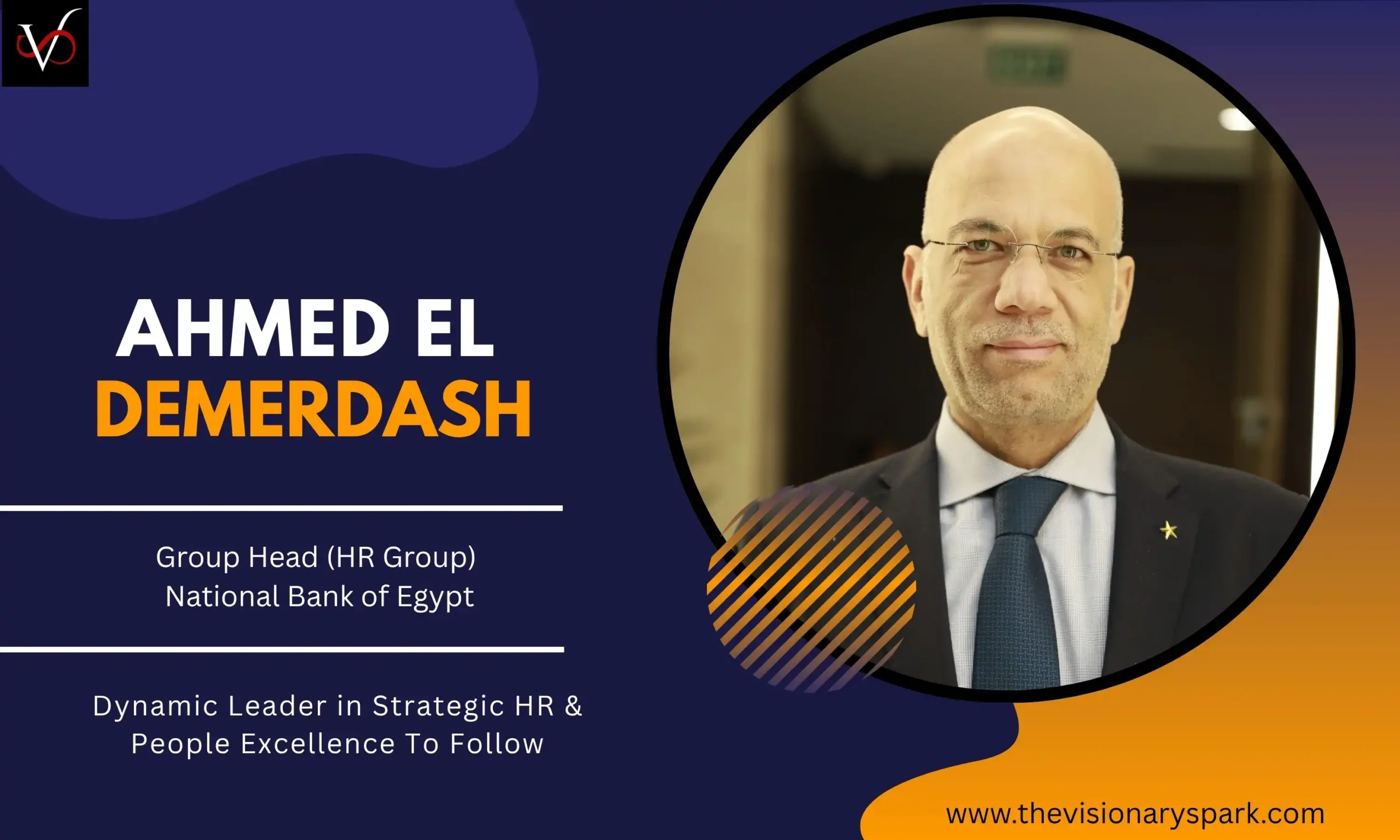
In today’s complex business environment, organizations no longer compete on strategy alone — they compete on their ability to translate strategy into sustained performance. At the center of this shift stands Ahmed El Demerdash, a strategic HR leader who has consistently redefined the role of human resources as a core driver of business value.
With over 25 years of leadership experience across banking, telecom, insurance, and multinational environments, Ahmed has led large-scale HR transformations impacting tens of thousands of employees and managing people strategies tied to multi-million-dollar budgets. His work goes beyond designing HR frameworks; it focuses on building integrated systems where talent, performance, and organizational capability operate as a unified engine for growth.
From HR Function to Performance System
Ahmed’s philosophy challenges a long-standing misconception:
HR is not a support function — it is a performance system.
Rather than operating at the periphery, he positions HR at the core of decision-making, ensuring that every people-related initiative directly contributes to measurable business outcomes. This approach has enabled organizations under his leadership to move from fragmented HR practices to cohesive, execution-driven models.
His guiding principle is simple yet powerful:
Start with the business — then design the people system to deliver it.
Translating Strategy into Capability
For Ahmed, strategy has no value without execution. His approach focuses on converting organizational ambition into real, scalable capability by:
- Building leadership pipelines that sustain long-term growth
- Aligning performance management with business priorities
- Embedding accountability across all organizational levels
- Leveraging HR technology to drive efficiency and decision-making
The result is not just alignment — but acceleration. Organizations become faster, more agile, and better equipped to navigate complexity.
Building High-Performance Cultures That Last
Ahmed believes that culture is not defined by statements — it is defined by behavior.
High-performance environments, in his view, are built on three non-negotiable pillars:
- Clarity — people understand not only what to do, but why it matters
- Accountability — ownership is embedded at every level
- Trust — teams are empowered to execute with confidence
When these elements align, performance is no longer managed — it becomes a natural outcome.
Leadership That Drives Impact, Not Process
Ahmed’s leadership style is grounded in outcomes, not activity. He challenges traditional leadership models that focus on control and replaces them with a model built on ownership and impact.
His leadership philosophy can be summarized in three actions:
- Empower people
- Align with strategy
- Deliver results
This approach has enabled him to lead complex transformations while maintaining clarity, engagement, and sustained performance.
A Distinct Perspective on Transformation
One of Ahmed’s defining strengths is his ability to lead change in complex organizations. He recognizes that transformation is not about systems — it is about people.
The real challenge is not designing change, but guiding individuals through it with clarity, trust, and purpose.
By aligning leadership development with business strategy, he creates a multiplier effect where improved capability drives performance, agility, and long-term resilience.
Global Mindset, Consistent Principles
Having worked across industries and geographies, Ahmed brings a global perspective grounded in three universal truths:
- Strong leadership drives results
- Adaptability sustains relevance
- Continuous learning fuels growth
Organizations that consistently invest in these principles outperform regardless of market conditions.
Values That Define Leadership
At the core of Ahmed’s leadership are three enduring values:
- Integrity builds credibility
- Fairness builds trust
- Continuous learning builds relevance
These are not abstract ideals — they are operational principles that shape decisions, behaviors, and organizational culture.
The Future of HR: Architecting Performance
Looking ahead, Ahmed sees a fundamental shift in the role of HR:
From function… to architect of performance.
The future will not be defined by HR processes, but by the ability to integrate People, Technology, and Culture into a unified system that drives sustainable business success.
Organizations that succeed will not be those with the best strategies — but those that can activate human capability at scale.
Closing Statement
In a world where strategy is increasingly accessible, the true competitive advantage lies in execution.
And execution, ultimately, is a people equation.
Ahmed El Demerdash is not redefining HR — he is redefining how organizations perform.