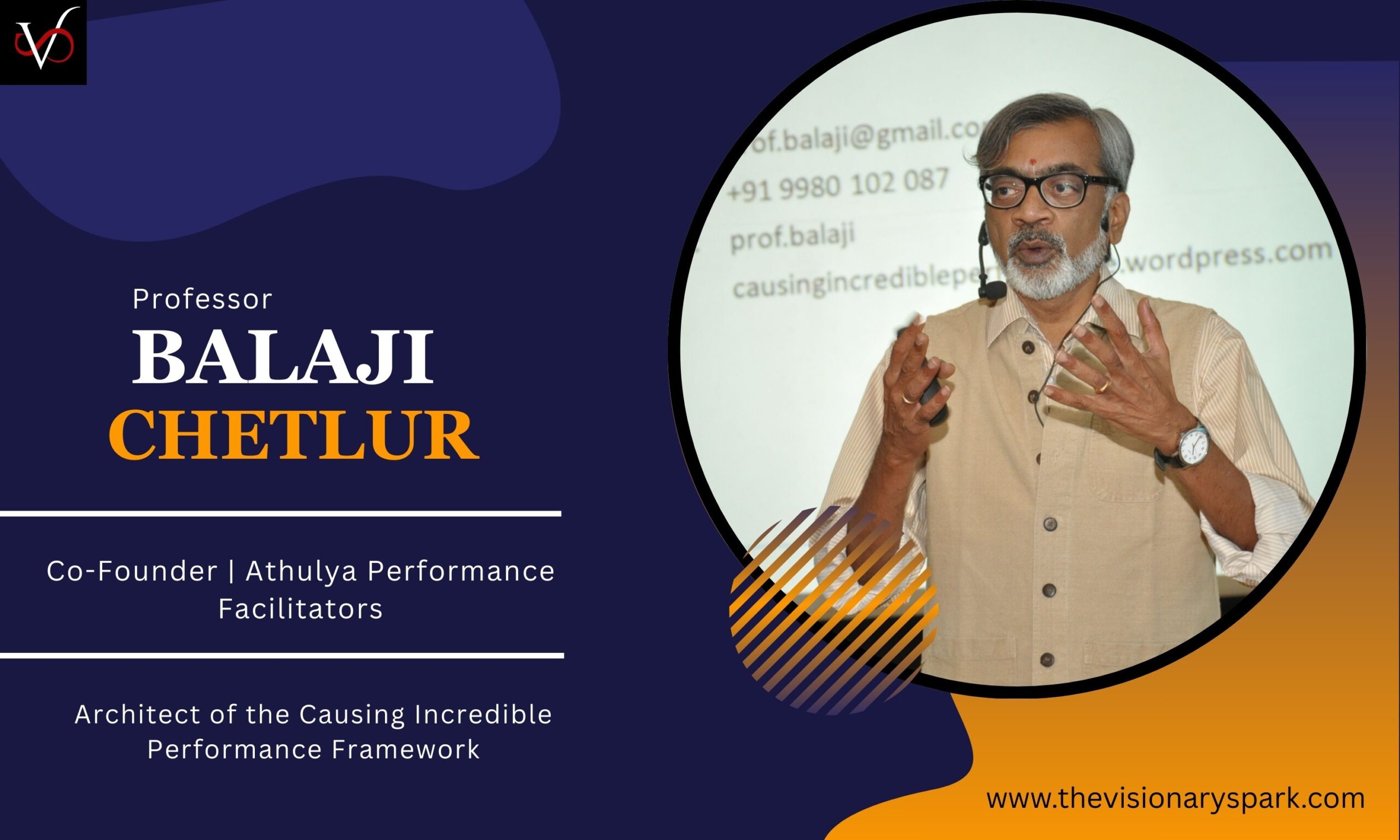
When Prof. Balaji Chetlur decided to step away from the structured world of organizational leadership in 2013, he found himself at a deeply reflective crossroads, one that would ultimately redefine how individuals and organizations think about performance. After nearly three decades across academia and the corporate sphere, he took a deliberate pause to ask himself a fundamental question: “What do I want my life to be about from here on?”
That inquiry became a powerful exercise in self-discovery. As he revisited the moments that had truly moved him over the years, four themes emerged with striking clarity: people, performance, learning facilitation, and a steadfast refusal to follow the ordinary path. These weren’t just interests; they were the essence of his professional and personal identity.
Around the same time, he began noticing a consistent pattern among the individuals and teams he had trained and coached. Across industries and backgrounds, people were producing extraordinary, measurable results — outcomes that exceeded what even they believed possible. This observation ignited a revelation: there was a deeper, teachable approach that could enable anyone, anywhere, to transcend conventional limits and achieve what he calls “incredible performance.”
And thus, the Causing Incredible Performance (CIP) Framework was born — an approach that distills years of experiential insight into a learnable model of extraordinary performance.
At its core, the CIP Framework rests on three deceptively simple yet profound axioms:
- Only results matter in life, ultimately.
- Only actions produce results.
- Only thoughts produce actions.
In essence, thoughts lead to actions, and actions lead to results. It is this clarity of linkage between intention and outcome that forms the heart of Prof. Balaji’s philosophy. The CIP Framework isn’t just a tool for performance; it’s a lens for living, one that empowers individuals to take charge of their thoughts, actions, and ultimately, their destinies.
The Science and Soul of Causing Incredible Performance
In a world overflowing with performance models, metrics, and management systems, Prof. Balaji Chetlur stands apart with a refreshing conviction: that it is the individual who has goals and takes actions. While he deeply values the contribution of existing performance improvement models, he points out that most focus heavily on systems, processes, and structures. Attention on individuals is, by and large, on competencies. What is needed is an approach that is comprehensive and learnable to produce extraordinary results and subsequent impacts. This need is what the CIP Framework meets.
The Causing Incredible Performance (CIP) Framework shifts that spotlight back where it belongs: on the individual. As Prof. Balaji explains, “It fully empowers the person aiming to cause incredible performance.” In his view, the individual alone sets the goal, takes the actions, achieves the results, and fulfills a deep-seated need in the process. Everything else — from systems to resources — supports that human effort. And individuals take actions even to get these supports.
Unlike traditional models that promote incremental gains, CIP is designed for quantum leaps in performance within the same context. It combines intensive personal coaching, daring goal-setting, and radical ownership to enable individuals to produce results that once seemed unthinkable. The framework doesn’t stop at ambition; it defines what an “incredible goal” truly is, helps individuals articulate it with clarity, and equips them with actionable steps to get there.
At the heart of CIP are ten Action Principles, which form a living, learnable system for extraordinary achievement:
- Commit and Account
- Reset Mind
- Be Present
- Simplify
- Declare an Incredible Goal
- Discover a Compelling Purpose
- Rally Others
- Execute with Ruthless Focus
- Fore-view for the Future
- Overcome Obstacles
Each principle comes with its own set of prescribed actions and practical tools, ensuring that philosophy turns into practice. What may appear as common-sense wisdom becomes transformative when applied with intent, discipline, and the right support.
But what truly sets CIP apart is how it elegantly bridges purpose and measurable performance outcomes. According to Prof. Balaji, people don’t chase goals in isolation; they act from a sense of meaning. CIP taps into that connection in two powerful ways: first, by encouraging individuals to choose results that contribute to a larger purpose they care about; and second, by guiding them to discover a compelling inner purpose — a personal drive or deep-seated need that finds fulfillment through achieving those results. In other words, purpose fuels performance, and performance, when achieved consciously, deepens purpose.
Central to this transformation is the mindset, which Prof. Balaji describes as the invisible engine of every action. “Only actions produce results, and only thoughts produce actions,” he asserts. Throughout the coaching process, participants are guided to observe and alter their own thinking patterns. He classifies these into two distinct types: “fact thoughts” (like nouns, verbs, and defined concepts) and “non-fact thoughts” (like adjectives, assumptions, interpretations, reasons, or self-talk). These categories, he notes, “cover every thought anyone has.” Recognizing the difference — and learning to act beyond limiting thoughts — becomes a foundational practice in achieving incredible outcomes.
While the framework does not explicitly include emotional intelligence as a construct, self-awareness is its living core. Through the process of altering thoughts, participants cultivate an intimate understanding of their inner narratives — their “voices” and dogmas, as Prof. Balaji calls them — the deeply held beliefs that often unconsciously restrict performance. As they work through the CIP methodology, people begin noticing mental clutter, overlooked details, or unrealistic expectations — all barriers to action that quietly shape their results.
In this sense, the CIP lies in its structure, but its soul resides in self-discovery. It is not merely about doing more; it’s about being more aware of what drives one’s actions and results. As Prof. Balaji and his colleagues’ work continues to demonstrate across sectors and continents, when individuals become conscious creators of their thoughts, actions, and goals, incredible performance is not just possible — it becomes inevitable.
From Concept to Culture: Applying CIP in Organizations
For Prof. Balaji Chetlur, the starting point of transformation is always the individual — even when the goal is organizational change. The Causing Incredible Performance (CIP) Framework, he emphasizes, does not focus on systems or hierarchies but on the people who bring those systems to life. “The framework doesn’t focus on organizations, but on individuals in organizations and outside them,” he notes firmly. It is a philosophy that believes every enduring cultural shift begins when individuals internalize a new way of thinking, acting, and achieving.
Yet sustaining a culture of “incredible performance” across an entire organization is no small feat. Prof. Balaji candidly acknowledges that maintaining the momentum after a one-time intervention can be challenging. However, he has observed remarkable evidence of continuity. Many participants who completed CIP projects continued to apply its principles long after the formal program ended. “We have episodic data showing that people sustain the results they produced during the one-time CIP Projects,” he explains. “We also know that many continue to practice parts of the framework in their daily lives.”
Encouraged by these sustained outcomes, Prof. Balaji and his team have recently developed an approach aimed at embedding a culture of incredible performance within organizations. He has even authored a paper outlining HR and Organizational Development (OD) interventions based on the CIP Framework, designed specifically to help companies thrive in today’s VUCA-BANI world (Volatile, Uncertain, Complex, Ambiguous – Brittle, Anxious, Nonlinear, Incomprehensible). “We hope organizations take this matter up,” he says with quiet optimism, confident that the framework can shape workplaces that are both resilient and purpose-driven.
When it comes to working across diverse sectors, the versatility of the CIP Framework is one of its greatest strengths. It has been successfully applied in sectors as varied as IT, pharmaceuticals, government, social development, public health, manufacturing, consulting, and education. “The CIP Framework is relevant as it is for different types of organizations, people in various roles, and all kinds of results they want to achieve,” Prof. Balaji explains. Rather than modifying the framework itself, his team personalizes its application through coaching on real-life CIP projects. Participants take up projects that align directly with their organization’s goals and their own roles, ensuring relevance and measurable impact.
This adaptive approach has led to hundreds of success stories, each one, in Prof. Balaji’s view, “transformational in its own way.” Among the 800-plus applications, a few stand out as particularly emblematic of CIP’s power.
He recalls the story of a technical sales executive from a B2B company who was tasked with achieving purchase orders worth ₹8 crores in a single quarter. Inspired by the CIP philosophy, the executive dared to set an incredible goal: ₹17.5 crores in just six weeks. The result? Over ₹20.5 crores in confirmed orders within that period. “The impact was so profound that he and his colleagues later declined the targets set for them in the following year,” Prof. Balaji recalls. “They said those targets were too low.”
Another remarkable instance comes from the public health sector. In a remote tribal district, a government health officer decided to apply the CIP Framework to combat anaemia among pregnant women. Traditionally, his team helped a maximum of 1,000 women improve their hemoglobin levels by 2 g/dL in three months. But with a renewed mindset and purpose, he set an incredible goal: to reach at least 4,000 women. By the end of the program, his team had impacted 6,235 women — more than six times the baseline. The ripple effects were far-reaching: reduced maternal and infant mortality, improved child health, decreased family anxiety, and a newfound wave of role models inspiring others in the community.
These stories — one from corporate India and another from rural public health — reflect the universality of the CIP approach. Whether in a boardroom or a village clinic, it proves that when individuals commit to extraordinary goals and align thought with action, incredible performance is not just possible; it’s replicable.
For Prof. Balaji, that is the true measure of success: when the CIP Framework transcends training sessions and becomes a living part of how people think, act, and lead. It is then that a concept truly evolves into a culture.
Evolving Performance in the Age of Change
As the world rapidly transforms under the weight of technological disruption and artificial intelligence, Prof. Balaji Chetlur approaches the subject with characteristic humility and groundedness. “This is too vast a subject,” he admits candidly, “and I am not competent to comment on it fully.” Yet, in that humility lies a clarity of thought. For him, technology and AI are tools, not replacements for human consciousness or effort. They belong within a larger principle of Simplify, one of the ten Action Principles of the Causing Incredible Performance (CIP) Framework. “Using technology is an action to simplify,” he explains. “It can remove unnecessary complexities that constrain performance. But one must guard against technologies that, instead of simplifying, add new layers of complexity.”
This pragmatic approach reflects his enduring belief that human performance cannot be outsourced to machines; it must be caused through awareness, intention, and disciplined action. Technology, in his view, should amplify clarity, not chaos. It must empower individuals to focus on what truly matters: purposeful results.
When it comes to his own philosophy as a teacher, coach, and facilitator, Prof. Balaji draws from a deeply internal compass. His four foundational values are simple, yet immensely powerful:
- Make it result-oriented, because without measurable outcomes, even the most inspiring ideas lose their relevance.
- Make it practical, because knowledge must translate into action.
- Make it simple, because clarity accelerates execution.
- Goad people to go beyond the ordinary, because greatness begins where comfort ends.
These guiding principles mirror the very essence of the CIP Framework itself — pragmatic, actionable, and profoundly human. They form the bedrock of his teaching and leadership approach, shaping every interaction and intervention he designs.
Asked how he balances structure and creativity in his facilitation programs, Prof. Balaji’s response beautifully encapsulates the art of mastery. “I go with the flow of the program, even as I have a broad structure,” he says. “Complete mastery over the subject is crucial for this.” His facilitation, therefore, is not a mechanical delivery of content but a dynamic conversation with the moment. It allows space for spontaneity, reflection, and deep connection, while remaining anchored in a robust conceptual framework. It’s a balance few can strike, but one that comes naturally to him through decades of experience across academic, corporate, and development contexts.
In discussing the challenges facing today’s leaders, Prof. Balaji offers a message that feels both sobering and empowering. “The world is extremely and increasingly competitive,” he observes. “And superimposed on that is the growing fragility of both the internal and external environments in which people work.” In this VUCA-BANI reality, he believes the only sustainable strategy is to become the worthiest — not merely to meet eligibility criteria, but to embody excellence.
This idea of worthiness is central to his vision of leadership. To him, true worthiness rests on three pillars: credibility, daring, and result-orientation. Credibility builds trust, daring drives innovation, and result-orientation converts vision into tangible impact. Together, they form the character of a high-performing leader. And once again, the CIP Framework provides the pathway to cultivate all three — through conscious thought, bold goal-setting, and consistent, accountable action.
In a time when uncertainty defines the norm, Prof. Balaji Chetlur’s philosophy stands out for its clarity, restraint, and timeless relevance. It reminds us that while tools and trends will continue to evolve, the real revolution in performance will always begin — and end — within the human mind.
Leadership, Learning, and the Human Factor
Every leader’s journey is shaped by moments of resistance, the voices that say, “Don’t do this.” For Prof. Balaji Chetlur, those very moments have been the sparks of innovation that defined his career and the creation of the Causing Incredible Performance (CIP) Framework itself. “The most frequent challenge that shaped my contributions,” he reflects, “has been others saying, ‘Don’t get into this.’ Therefore, I get into those.”
One of his defining experiences came while leading the Learning and Development function in a corporate setting. Driven by his passion for meaningful learning, he designed an ambitious program on People Management — an intensive series of ten to twelve full-day classroom sessions, conducted every fortnight over five to six months. The idea was to immerse participants in a transformative journey rather than offer yet another short-term workshop.
When he presented the plan to senior business unit heads, the response was almost unanimous: discouragement. “No one will participate in a program that long,” they warned. But Prof. Balaji persisted, guided by conviction rather than convention. The result? The program was not only launched, but it thrived — completed by over ten batches, each with an average of twenty participants. It was a powerful validation that learning, when designed with purpose and persistence, can defy organizational skepticism. More importantly, this experience laid the groundwork for the CIP Framework — built on the belief that true transformation happens when people engage deeply, not superficially.
When asked how he defines incredible performance in a world obsessed with numerical success, Prof. Balaji offers a characteristically balanced view. “We define incredible performance as achieving incredible goals,” he says. These goals, though quantifiable, are not just about numbers; they are about converting problems and dreams into measurable result statements. The process demystifies ambition, turning lofty aspirations into actionable outcomes. “Once you do that,” he adds, “setting incredible goals becomes simple.” It’s a method that transforms wishful thinking into structured achievement, bridging the gap between imagination and implementation.
However, Prof. Balaji is quick to clarify that the CIP experience is far from a traditional classroom session. One of the most common misconceptions he encounters is the assumption that CIP is just another instructor-led training program — a few hours of lecture and information sharing. “Incredible performance cannot happen in this manner,” he emphasizes. Instead, CIP interventions are activity-based, experiential, and sustained through one-on-one coaching. Participants don’t just learn concepts; they apply them to real-life goals over a period of three months, with guided reflection and action. This learning-by-doing approach ensures that the framework is not merely understood intellectually but lived experientially.
The results of these interventions speak for themselves. Success, as Prof. Balaji defines it, is measured not by attendance or satisfaction surveys, but by impact — the number of people who achieve and even surpass their incredible goals and deliver results far beyond business-as-usual or even stretch targets. “Wherever possible,” he adds, “we also indicate the larger ripple effects these results create.” Those ripple effects often extend beyond the workplace, improving confidence, relationships, community outcomes, and even individual well-being.
For Prof. Balaji, leadership and learning are not abstract ideals. They are grounded in courage, clarity, and commitment — the courage to take on what others doubt, the clarity to transform dreams into measurable goals, and the commitment to walk alongside people as they achieve the incredible. His story is a testament to how human-centered leadership, when practiced with consistency and conviction, can turn the improbable into the inevitable.
Athulya’s Ethos and the Future of Performance
Behind every extraordinary performance lies a method — a disciplined process that transforms potential into measurable impact. At Athulya Performance Facilitators, this process is both structured and deeply human. As Prof. Balaji Chetlur explains, a typical Causing Incredible Performance (CIP) intervention unfolds through a carefully designed sequence that blends group learning, personal reflection, and one-on-one coaching.
It begins with a strategic introduction of the framework to key decision-makers within an organization. This step is crucial; it ensures leadership alignment and secures the commitment necessary to sustain the transformation ahead. Once the foundation is set, Module 1 commences: a two-to-four-day group workshop, typically involving 15 to 30 participants. Facilitated by two experienced trainers, these workshops are dynamic, immersive experiences combining both indoor and outdoor activities. Participants are guided through the core concepts of the CIP Framework, with the CIP Handbook serving as their constant reference point — a practical manual for mastering the art of causing incredible performance.
Module 2 takes the learning from concept to reality. Over a period of three months, participants apply the framework to achieve real-life, real-time incredible results — goals that push the boundaries of what they once thought possible. This phase is powered by weekly one-on-one coaching sessions, each lasting about an hour, alongside a few group sessions that allow participants to learn from one another’s journeys. Accountability is an integral part of the process: each participant submits a structured progress report, practicing one of CIP’s key principles: “Commit and Account.”
The intervention culminates in a closing ceremony, where participants share their experiences, facilitators present a summary of the results achieved, and certificates are awarded. But more than recognition, what participants take away is a renewed sense of agency — an understanding that they themselves are the source of their performance breakthroughs.
For Prof. Balaji, the fuel that keeps this movement alive is not numbers or milestones; it’s wonderment. “With every incredible performance caused,” he reflects, “I am in wonderment about the possible impacts on the larger society.” Each conversation with participants, facilitators, and coaches gives him new insight into how the framework works in real-world contexts. Recently, Athulya introduced the Master Class on CIP for consultants, coaches, and trainers — a Level 1 Certification program that’s already seeing enthusiastic participation. One of his associates has also launched a technology-based platform to scale the delivery of CIP interventions, expanding access while preserving the integrity of the experience.
Looking to the future, Prof. Balaji envisions a global movement rooted in the principles of incredible performance. His five-year vision for Athulya and the CIP ecosystem is ambitious yet grounded in purpose:
• To take CIP global by developing facilitators and coaches across multiple countries.
• To scale interventions rapidly, reaching larger numbers of individuals and organizations.
• To apply CIP to public systems, including governance, social development, and community leadership, amplifying its societal impact.
• To introduce shorter, focused interventions through the Access to Performance Series, designed for quick and targeted application.
Yet at the heart of all this growth, his message is deeply inspiring. “Every one of us can produce results far higher than what we are producing now, in every aspect that matters to us,” he says. “Be bold enough to embark on and sustain the journey toward this. The proven CIP Framework is there to help you. We owe this to our organizations, to society, and most importantly, to ourselves. Act now.”
In those words lies the very essence of the Athulya ethos — performance not as a corporate pursuit, but as a personal responsibility. For Prof. Balaji Chetlur, causing incredible performance isn’t just about achieving more; it’s about awakening the best within each of us, so that the extraordinary becomes not the exception, but the new normal.

Prof C Balaji
Co-Founder and Director
Athulya Performance Facilitators
A Fellow of IIM, Ahmedabad, Prof C Balaji was in academics for 17 years and in the corporate sector for almost 13 years. He has expertise in Human Resource Management, Behavioral Science, Organisation Development, and Research Methods. He has taught in PhD-level and MBA-level programs; conducted training programs for managers and leaders; facilitated organization change interventions; conducted and guided research; and published books, papers, and articles.
Balaji is eclectic and non-conventional in his work that creates new paradigms of ways of being, thinking, acting, and behaving.